
2012 Election Preview: The Final Rankings
Editor’s Note: This morning, we issued a press release on the national wires that ranks the 18 most likely 2012 Republican contenders – and President Obama – on their communications skills. Below, you’ll find the full text of that release.
FOR IMMEDIATE RELEASE
2012 Presidential Election: 18 Republican Contenders and President Obama Ranked By Communications Skills
Better Communicator Has Won Every General Election Since Beginning of 24/7 Media Age in 1980; Marco Rubio, Haley Barbour, Mike Huckabee Rank Highest
December 15, 2010 (Washington, DC) – Marco Rubio, Haley Barbour and Mike Huckabee are the Republican candidates most likely to defeat President Obama in 2012, according to a new analysis released today.
The study assesses the 18 most likely Republican candidates – and President Obama – on the seven traits all winning presidential candidates have had since the beginning of the 24/7 media age in 1980. The 7,500-word series appears on the Mr. Media Training Blog, one of the world’s most visited communications training websites.
“Most pundits analyze a general election by looking at the same old measurements, such as unemployment data, consumer confidence, and early polling,” said Brad Phillips, author of the analysis and a former journalist with ABC News and CNN. “But they always miss a reliable predictor: the more gifted media spokesperson has won every presidential election since the beginning of the 24/7 media age in 1980.”
The grades below reflect how well each candidate is performing in seven specific communications categories:
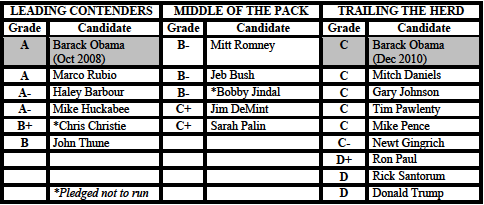
- The candidates were evaluated on the following seven criteria, which have held true for every general election since the beginning of the 24/7 media age in 1980:
- The candidate with the clearest message has always won
- The candidate who articulated the clearer vision has always won
- The sunnier candidate with the more optimistic message has always won
- The candidate whose message is best aligned with constituent concerns has always won
- The more charismatic candidate has always won
- The candidate who appeared most comfortable in his skin has always won
- The candidate who uses the most plain-spoken language has almost always won
“Although we tend to complain about the length of presidential campaigns, the reality is that nonstop media exposure to candidates gives us a good sense of who they are,” said Phillips, who authors the Mr. Media Training Blog. “That’s important, because many voters – especially the crucial independents – base their votes on their personal comfort level with a candidate, not specific policy positions.”
This study is based on how the candidates are doing now, but points out that many of the contenders will improve between now and the election, while others will likely get worse.
Note: This analysis applies solely to the 2012 general election, not primary elections.
###
Brad Phillips is chief executive of Throughline Group, a media and presentation training firm. (Previously, he was president of Phillips Media Relations, a media and presentation training firm.) He previously worked as a journalist with ABC’s Nightline with Ted Koppel and CNN’s Reliable Sources and The Capital Gang.
Share this article
- Share on Facebook
- Share on Twitter
- Share on LinkedIn
- Share on Email


question- How do you beat Obama in 2012
answer- With a CAIN (Herman Cain)
Why no coverage on Herman Cain the winner of the SC debate and Obamas worst nightmare?
John – I did this series in December of 2010, before Herman Cain was in the race. My review of the first GOP debate included coverage of Mr. Cain, and reviewed his performance favorably.
Brad