
Eight Great Ways To Open A Speech (Part One)
Almost every speaker I’ve ever trained begins their practice speech the same way.
They walk to the front of the room, say good morning/afternoon/evening, thank the audience for coming, and express their delight to be there. Then they turn around and flip to their first slide, a bulleted agenda of what they plan to discuss during their presentation.
What a bore.
The opening minutes of a presentation are often the most important. According to Allan and Barbara Pease, authors of The Definitive Book of Body Language, the audience forms 60 – 80 percent of its impression of a speaker within the first four minutes.
Over the next three days, you’ll learn eight great ways to open a speech, each with an example. Today, we’ll begin with two of the most popular openings: the startling statistic and the anecdote.
 Opening Number One: The Startling Statistic
Opening with a startling statistic is a terrific way of grabbing the audience’s attention from your first word. In order to be effective, the statistic should be related directly to the main purpose of your talk.
“Statistic” doesn’t mean the same as “data.” If you’re giving the audience a number, you should set it within a broader context to help infuse it with greater meaning.
For example, I occasionally speak to a group of part-time volunteers who are working to reduce the number of injuries suffered in house fires. I used this opening for one of my talks:
“I’m only going to speak to you for one hour this morning. During our hour together, someone, somewhere in America, is going to be badly injured in a house fire. By the time you begin lunch this afternoon, someone, somewhere in America, will die in a house fire. By dinner, another person will die. By the time you go to sleep, another person will die. As you sleep tonight, two more people will die.
I’m here today because I want to prevent that from happening. And I’m going to need your help.”
Opening Number Two: The Anecdote
A story, case study, or personal anecdote is perhaps the single most effective tool for transferring information from speaker to audience. In fact, Harvard Professor Howard Gardner once said that “stories are the single most powerful weapon in a leader’s arsenal.”
One of my favorite speech openings of all time came from Brian, a client who delivered a speech on a “boring” topic, new insurance products. But instead of putting his audience to sleep, he used a personal anecdote to give his talk greater meaning.
Brian told the story of a woman he met early in his career, a grieving widow named Pam, whose husband, James, had recently died. James had been sick and out of work for three years, so they had no choice but to stop paying his life insurance premium. As a result, Pam wasn’t going to get a penny from his life insurance policy, meaning she would struggle to make ends meet. But Brian discovered a loophole in the policy, and delivered a $100,000 check to Pam weeks later.
Brian then transitioned to the body of his presentation by placing that story in context:
“When I think about the power of what we do, having been to retirement parties, having sent those kids off to college and shown individuals how to pay for it, that’s very powerful. But nothing was more powerful than delivering a check in the face of tragedy. That mindset, for me, changed everything.”
You can read part two of this series here.
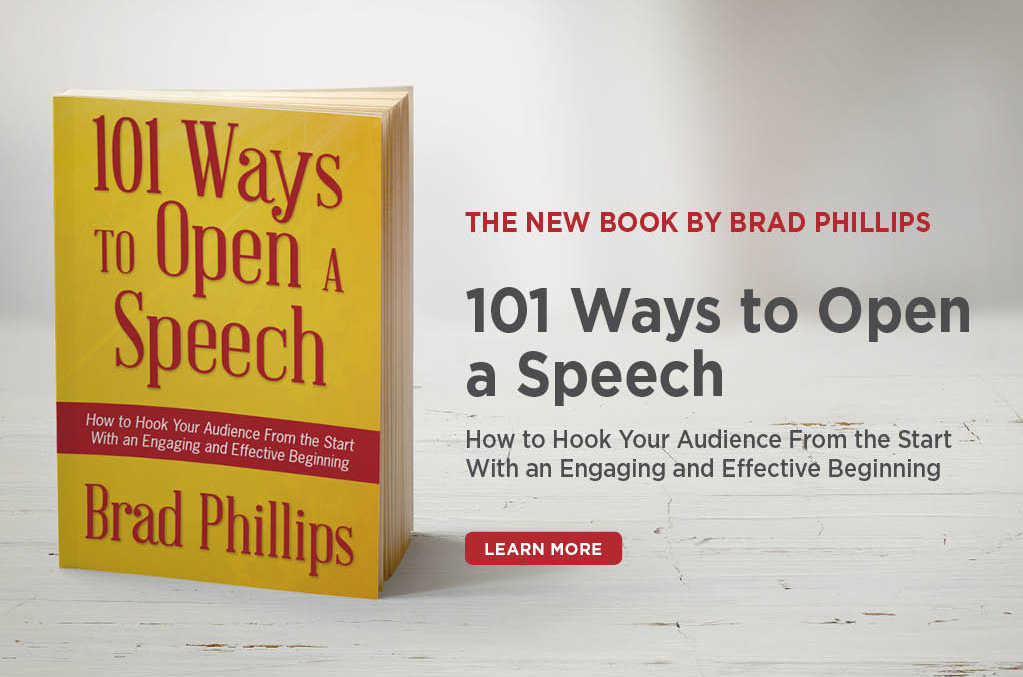
My new book, 101 Ways to Open a Speech, is now available at Amazon. You can read more about the book here.
Share this article
- Share on Facebook
- Share on Twitter
- Share on LinkedIn
- Share on Email



Another must share with public speaking students!
Amy,
Thanks so much! It’s so nice to know this work is being used to help students become more effective public speakers. I hope it benefits them throughout their careers.
Best wishes,
Brad
It was very helpful for me to know how to open up to give a speech.
very helpful to those neophytes in public speaking
Glad to hear that, Pilita. Best wishes for you in your upcoming presentations!
Best,
Brad
This helped me a lot for my speeches. You should make more of these!
this helped me a lot and i gave my best in my speech!!!!!!
Great stories in those examples! One thing they have in common is a highly emotive component.
You might like these 3 video examples as well. Two of them are from the TED world, and mention fatality (like the examples you used). Such a serious point really gets people to take notice! The 3rd video isn’t as emotive – it’s about content marketing – but it still presents a number in a suitably attention-grabbing way.
There’s certainly good reason to “start strong”, as I call it. Statistics and stories are 2 of the best ways, for sure.
I have this source helpful. As a grade 11 learner I have improved a lot when it’s comes to presentation or delivering a speech. I thank you!
Thank you so much for revealing the startup. It uplifts my spirit immensely!
Thank you so much… This helped me for my speech
Wow!..with this information I hope to make the best speeches ever.I never thought of this kind of techniques but now my eyes are open.Thank you guys